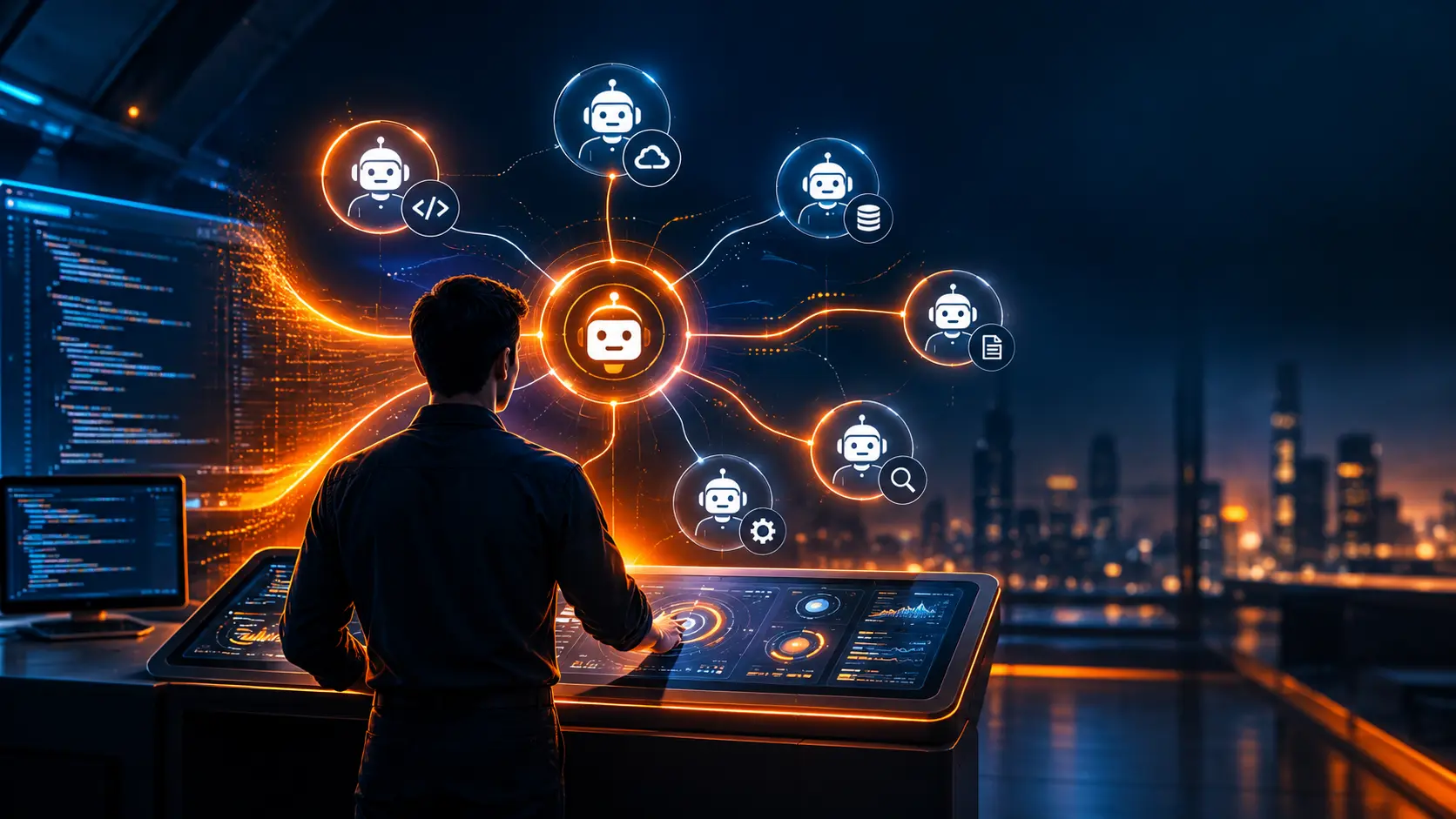
Introduction: The Moment Manual Coding Became "Optional"
In January 2026, Boris Cherny, head of Claude Code at Anthropic, made a statement that reverberated across social media: "It's been 100% for me for two+ months now, I don't even make small edits by hand. I shipped 22 PRs yesterday and 27 the day before, each one 100% written by Claude." [citation:13][citation:18]
This wasn't just a personal claim. An internal Anthropic report in June 2026 confirmed that in Q2 of that year, code output per engineer was eight times higher than before 2025, and over 80% of code merged into the company's official repository was written by Claude [citation:1][citation:7].
What does this mean for B2B engineering teams? A clear message: a developer's value is no longer in typing speed, but in the ability to direct, review, and make decisions about agent output. In this article, we examine this shift using credible 2026 reports.
Three Eras of the Developer Role
To understand the depth of this change, let's look at three distinct eras:
Era 1: The Manual Age (Pre-2021)
Developers translated business requirements into precise machine instructions. Every variable, loop, and API call was typed by hand. The bottleneck was typing speed and syntax mastery [citation:16].
Era 2: The Copilot Age (2021–2024)
Tools like GitHub Copilot emerged, suggesting code as developers wrote comments or function signatures. The bottleneck shifted from "code production" to "code consumption and review." Developers had to read and verify massive volumes of suggestions [citation:16].
Era 3: The Agentic Age (2024–Present)
Agents like Claude Code, Cursor, and Devin don't just write code—they read repository structures, run tests, inspect failures, and self-correct until tests pass. The bottleneck has shifted from "reading code" to "defining architecture, context boundaries, and intent" [citation:16].
Real Data: How Much Are Agents Working?
Anthropic's October 2026 report, "How Employment is Changing at Anthropic," revealed striking data:
- By August 2026, interactive agent work hours were 6 times employee work hours [citation:2][citation:8].
- The share of junior-level technical hires dropped from 27% to 9% [citation:2][citation:19].
- Code commits per engineer reached 5 times their level from six months earlier [citation:2].
- About 80% of interactive session time was idle while agents waited for human input [citation:2].
These numbers reveal a reality: code production is no longer the bottleneck. The bottleneck is human capacity to review, decide, and direct.
New Skills: What Replaces "Coding Speed"?
Based on Anthropic and Gartner reports, developer value in 2026 is concentrated in three areas:
1. Architecture and System Design
Agents can write code, but deciding what should be built, how it should be layered, and where module boundaries lie still requires human judgment. An industry report shows 75% of developers manually review every AI-generated snippet before merging [citation:3]. This review is impossible without deep architectural understanding.
2. Spotting Flaws in Rapid Output
When an agent generates a pull request in three seconds, the ability to spot flaws in it becomes critical. James Ivers of Carnegie Mellon University says: "We are replacing one imperfect actor (humans) with another (AI). AI is imperfect and there will be mistakes. Software engineers are uniquely positioned to anticipate where errors can be introduced, spot them in practice, and guide the AI back toward intended solutions." [citation:5]
3. Defining Agent Authority Boundaries
An autonomous agent without clear boundaries can be disastrous. Developers must define: what parts of the repository can the agent access? What commands can it execute? When must it stop and request human approval? This concept is known in 2026 reports as "Harness Engineering" [citation:4][citation:10].
# ❌ Anti-Pattern: Agent without clear boundaries
# If you tell an agent "fix this bug" without scope, it might modify critical files.

# ✅ Recommended: Defining agent authority boundaries
AGENT_BOUNDARIES = {
    "allowed_paths": ["src/features/payment/"],
    "forbidden_actions": ["delete_database", "modify_env_files"],
    "require_human_approval": ["deploy_to_production", "modify_auth_layer"],
    "test_before_commit": True
}
# These boundaries are communicated to the agent in the system prompt or tool configuration.
Organizational Implications: Smaller Teams, Higher Expectations
Gartner predicts that by 2030, software engineering teams will become smaller but more numerous. Each team will have 2 to 5 members and be fully accountable for a product or feature [citation:20]. This means each team member must possess a broader range of skills: from business understanding to agent oversight.
Meanwhile, Anthropic reports that employees are spending more time in meetings (20% more than a year earlier) and a new type of work called "meta-work" has emerged: building dashboards, writing instructions for agents, and monitoring pipelines. This work rose from 10% of sessions in fall 2025 to 22% in spring 2026 [citation:2].
How to Manage This Transition in Your Team with Us
At IP DALIN, we see this shift not as a threat, but as a role elevation. Our teams use agentic tools to accelerate production, but architectural decisions, final reviews, and authority boundaries remain with senior engineers.
If your engineering team is ready for this transition but unsure where to start, contact us.
Frequently Asked Questions (FAQ)
Will developers lose their jobs?
No, but their role changes. Demand for "manual coding" declines, but demand for "engineers who can orchestrate agents, define architecture, and review output" increases. Gartner predicts 75% of engineering leaders expect headcount to remain the same or grow [citation:20].
Is coding skill no longer important?
It is important, but not sufficient. If you don't know how to code, you cannot evaluate agent output. Gartner warns that reducing focus on coding skills can be dangerous, as "final judgment about AI-generated code requires deep understanding" [citation:15].
What skills should we develop?
Three areas: software architecture (Clean Architecture, DDD), the ability to review and spot flaws in generated code, and the skill of defining authority boundaries and system prompts for agents.
Can agents work without human oversight?
For some limited tasks, yes. But for B2B projects where security and data integrity are critical, human oversight remains essential. Anthropic's report shows 80% of interactive session time is spent waiting for human input [citation:2].
Where do we start?
Start with a small project: delegate one feature to an agent, but define authority boundaries precisely and review output carefully. The initial goal is not speed; it's learning how to collaborate effectively with agents.
About IP DALIN:
IP DALIN Software Engineering Studio specializes in Clean Architecture, Domain-Driven Design, and enterprise application development, helping businesses build software that adapts to future changes.